2026-09-16
Retail Signage Cost: What Drives the Price Up or Down
By Bryce Mitchell — Founder, Rapid Retail Graphics
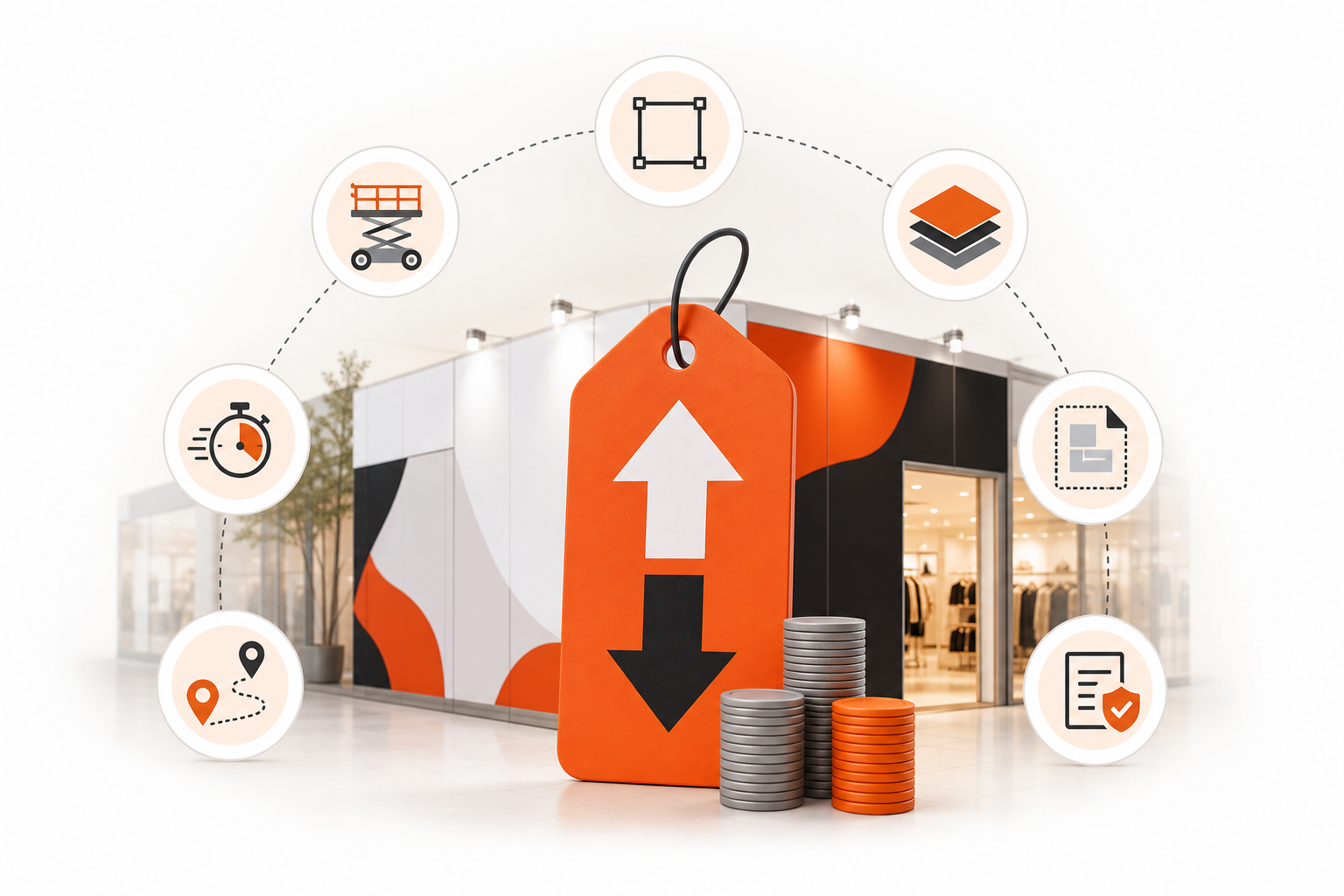
Retail signage cost looks like a simple budget line until you're actually pricing a project. Then the variables multiply. Substrate choice, square footage, installation complexity, landlord compliance, lead time pressure — each one moves the number, and the gap between a straightforward job and a complicated one can be substantial.
If you're a leasing coordinator, brand manager, or retail construction manager trying to build an accurate budget before your fit-out clock runs out, here's what actually drives the cost — so you can anticipate it rather than absorb it.
What "Retail Signage" Actually Covers
"Retail signage" is a broad category. It includes permanent fascia signs, interior wayfinding, window graphics, promotional displays, and construction hoarding panels. Each type has a different cost profile.
This article focuses on large-format graphics — the kind used during fit-outs, renovations, and lease-up periods. Hoarding panels, barricade wraps, temporary promotional walls. These are the formats where cost variables are most pronounced and where budget surprises are most common.
If you're sorting out how hoarding graphics differ from permanent signage in terms of regulatory approval and landlord requirements, the differences between retail signage and hoarding graphics affect both the process and the price.
The Primary Cost Drivers
1. Square Footage
The most direct driver. More surface area means more material, more print time, more installation labor. Large-format retail graphics are priced per square foot, so total panel area is the starting point for any estimate.
A single-storefront hoarding installation typically covers 200 to 400 square feet. A corner unit or flagship with extended lease line frontage can easily exceed 1,000. The per-square-foot rate stays relatively consistent — the total scales directly with coverage area.
Rapid Retail Graphics prices standard hoarding at approximately $6 per square foot, inclusive of print and standard installation. Final pricing is confirmed after reviewing site photos and drawings, since the number can shift based on what the site actually involves.
2. Substrate and Material Specification
Not all hoarding panels use the same substrate. The material affects print quality, durability, and sometimes landlord approval — and landlords occasionally specify what's acceptable.
Common substrates include vinyl wraps applied over existing hoarding boards, PVC foam board, Coroplast, and rigid aluminum composite panels. Vinyl wraps are typically the most cost-efficient option for temporary installations. Rigid substrates cost more per square foot but may be required in certain mall environments or for installations expected to stay up for an extended period.
If the landlord's hoarding specification calls for a particular substrate, that requirement overrides your cost preference. Factor it in early.
3. Artwork Complexity and File Readiness
Artwork production is a cost variable that gets underestimated more often than any other.
If you're supplying production-ready files adapted to the exact panel layout, the artwork component is minimal. If the files need significant work — resizing campaign creative to fit non-standard panel dimensions, extending backgrounds, rebuilding elements that don't exist in high resolution — that adds time and cost.
A brand manager with a clean asset library and a straightforward panel layout will pay less for artwork than a leasing team trying to adapt a campaign designed for a completely different format.
The practical rule: the closer your files are to production-ready, the lower your artwork cost. Vendors who handle artwork in-house, as part of the project rather than as a separate scope, give you more predictability here.
4. Installation Complexity
Standard installation — a ground-floor hoarding run in a mall with accessible panels and a clear installation window — is priced into most base rates. Complexity pushes the cost up.
Factors that add to installation cost:
- Height. Panels above standard reach require lifts or scaffolding. That equipment costs money to source and operate.
- Access restrictions. Tight mall corridors, limited loading dock access, or restricted elevator use all add time.
- After-hours requirements. Most mall installations happen outside trading hours to avoid shopper disruption. That's standard practice — but if the available window is narrow, say two hours between midnight and 2 a.m., the crew has to work faster or larger, which affects labor.
- Multi-level or atrium installations. These involve more coordination with mall operations and often require additional safety measures.
If your site has any of these conditions, flag them upfront. An estimate built on a simple installation assumption will be wrong if the site is anything but.
5. Lead Time and Rush Requirements
Standard lead time from site survey to completed installation runs 3 to 5 business days for a full-service hoarding project. That window covers survey, artwork production, print, and installation.
When it compresses, cost goes up. Rush production means prioritizing your job in the print queue. Rush installation may require a crew on shorter notice or outside a preferred window. These aren't arbitrary charges — they reflect real resource constraints.
If your store opening date is fixed and the timeline is already tight, build the rush premium into your budget rather than assuming standard lead time will hold.
6. Project Scope: Single Location vs. Multi-Location Program
A single-location installation is priced straightforwardly. A multi-location program introduces coordination complexity that moves cost in both directions.
On the savings side, a national program with consistent panel specifications across multiple sites can achieve economies of scale on print production. The artwork is adapted once; the print run is larger.
On the cost side, coordinating installation across multiple markets means managing multiple mall operations teams, multiple approval timelines, and multiple installation crews. That coordination has a cost, whether the vendor absorbs it or passes it through.
A national fashion retailer running a 12-location mall fit-out faces a fundamentally different logistics problem than a single-store operator. The per-square-foot rate may be similar. The total project management load is not.
7. Landlord Compliance Requirements
This is the cost driver that catches the most people off guard.
Different mall landlords have different hoarding specifications. Cadillac Fairview, Oxford Properties, and Ivanhoé Cambridge each have their own submission requirements, approved substrate lists, and installation standards. Simon Property Group properties in the United States have their own set. Non-compliance means rework, and rework is expensive.
If your vendor doesn't know these requirements going in, you'll find out about them after the artwork is produced or after the panels are installed. Either scenario adds cost — and more importantly, adds time you probably don't have.
Working with a vendor who has documented familiarity with landlord-specific compliance requirements is worth paying for. A compliant first submission always costs less than a rejected one.
What Doesn't Drive the Cost Up (But People Assume It Does)
Geographic Location
Within North America, the per-square-foot rate for hoarding graphics doesn't vary dramatically by city. New York, Toronto, Chicago, Los Angeles, Dallas — print cost is similar across markets. Installation labor rates vary somewhat, but not as much as people expect.
What does vary is access complexity. A downtown Manhattan installation with limited loading access and a narrow overnight window is more complex than a suburban mall with a dedicated service corridor. That complexity is a cost driver. The city itself is not.
Brand Complexity
A highly detailed brand identity doesn't automatically cost more to print. Large-format print handles complexity well. What costs more is poor file preparation — low-resolution assets, incorrect color profiles, files that need rebuilding. The brand isn't the issue. The file quality is.
Temporary vs. Permanent: A Cost Comparison Point
Temporary hoarding graphics and permanent signage have different cost profiles over time. Permanent fascia signs involve higher upfront fabrication costs but are designed to last years. Temporary hoarding is lower cost per installation and gets replaced when the fit-out is complete.
For a construction period running 4 to 12 weeks, temporary hoarding graphics are almost always the more cost-efficient choice. When temporary retail graphics make more sense than permanent signage is worth working through before you commit to a format.
How to Build a Realistic Budget
Start with these inputs:
- Total panel area in square feet. Measure the hoarding run, including returns and any secondary faces. If you don't have exact measurements, a site survey will produce them.
- Substrate requirement. Check the landlord's hoarding specification before assuming vinyl wrap is acceptable.
- Artwork status. Assess whether your files are production-ready or need adaptation work.
- Installation conditions. Note any height requirements, access restrictions, or narrow installation windows.
- Timeline. Confirm whether standard lead time fits your opening date or whether rush production is needed.
- Number of locations. If this is a program rather than a single site, factor in coordination overhead.
With those inputs, you can build a number that holds. Without them, any estimate is a guess.
Rapid Retail Graphics has an instant estimate calculator at rapidretailgraphics.com that gives you a working number before you've committed any time to a formal quote process. Project budgets typically run from $5,000 to $30,000 depending on scope — the calculator helps you understand where your project lands before the conversation starts.
The Cost of Getting It Wrong
A missed installation deadline doesn't just mean a delayed opening. In a mall environment, it can mean a landlord penalty, a dark storefront during a key trading period, and a brand manager explaining to the executive team why the flagship launch didn't happen on schedule.
The cheapest quote is rarely the cheapest outcome. A vendor who misses the installation window, produces panels that fail landlord inspection, or requires rework because the artwork wasn't adapted correctly costs more in total than a vendor who charges a mid-market rate and delivers a compliant, on-time install.
That's not an argument for paying more than necessary. It's an argument for pricing the full scope accurately — coordination, compliance, and timeline risk included — rather than optimizing for the lowest per-square-foot number in isolation.
FAQs
The variables that drive retail signage cost are predictable once you know what to look for. Square footage, substrate, artwork readiness, installation complexity, lead time, landlord compliance — get those inputs right and your budget will hold. Miss one and the number shifts after you've already committed.
Get a working estimate or send us your project details before the timeline gets tight.
Have a hoarding project coming up?
Get a Quote