2026-09-23
Hoarding Graphics Delivery Time: What 3–5 Days Really Means
By Bryce Mitchell — Founder, Rapid Retail Graphics
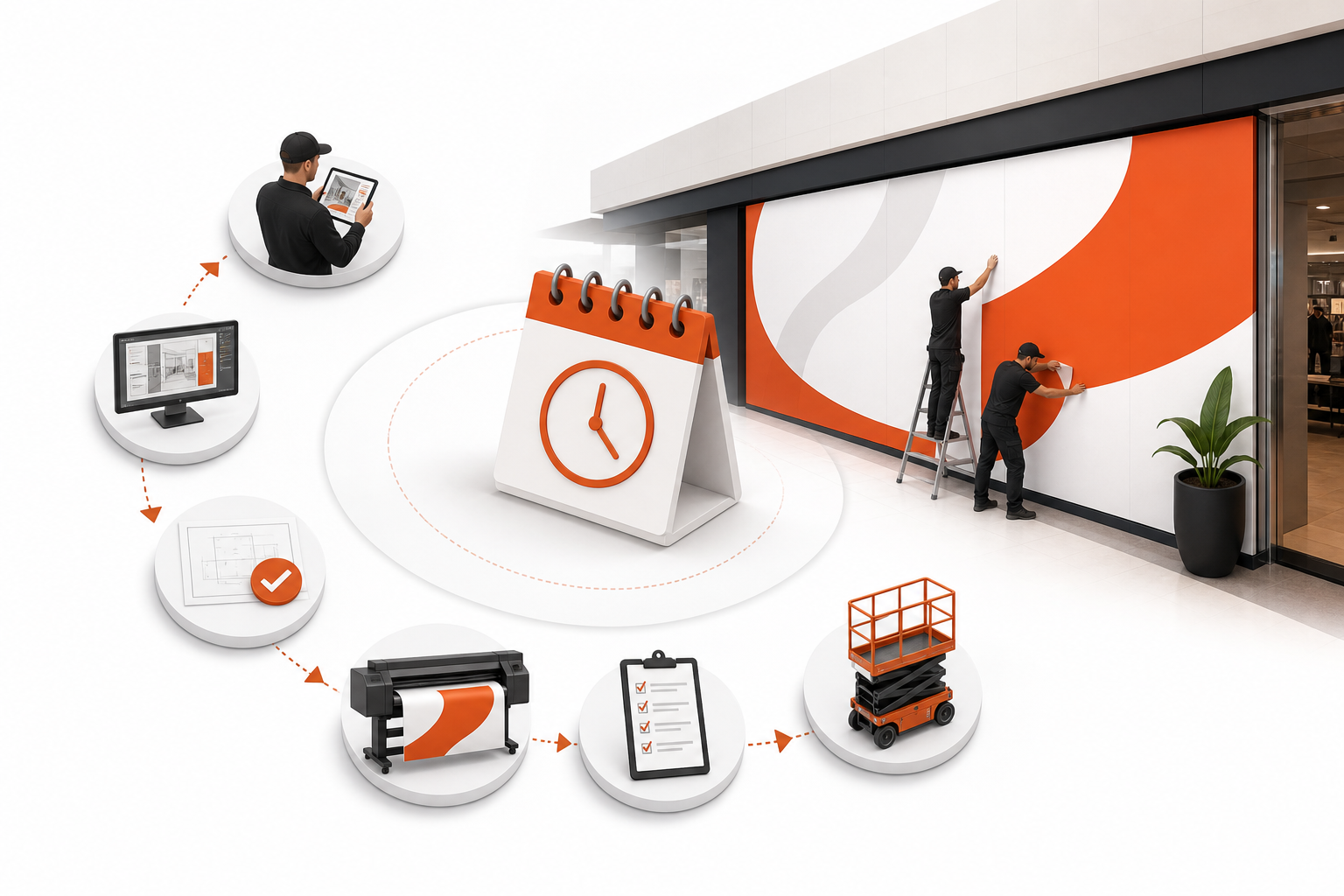
You have a lease signed, a fit-out clock running, and a store opening date that does not move. The hoarding needs to go up before construction starts, and you need to know exactly how long that takes. "3 to 5 business days" is the number that matters — but what that window actually covers, and what has to happen inside it, is worth understanding before you commit to a vendor or a schedule.
Here's what hoarding graphics delivery looks like stage by stage, what compresses it, what expands it, and what to watch for when you're working against a fixed handover date.
What the Clock Actually Starts On
The most common scheduling mistake is treating "3 to 5 business days" as a countdown from the moment you place an order. It isn't. The clock starts when the vendor has what they need to begin.
That means:
- Confirmed site dimensions or a completed site survey
- Approved artwork, or a brief that allows artwork production to begin
- Mall operations approval, or a confirmed approval window
- Access confirmation for the installation date
If any of those are missing on day one, the lead time hasn't started yet. It starts when the file is ready to go to print and the install date is confirmed with mall ops. That distinction matters a great deal when you're working backward from a hard opening date.
The 6 Stages Inside the Window
A full-service hoarding graphics delivery isn't a single step — it's a sequence. Understanding where time gets consumed helps you protect the schedule.
Stage 1: Site Survey and Measurements
Before any artwork gets produced, someone needs accurate panel dimensions. Lease drawings are often wrong. Panels that look uniform in a floor plan may vary by several inches in the field. A site survey catches those discrepancies before they become a reprint.
For vendors operating a single-vendor model, the survey feeds directly into artwork template production. No handoff to a separate measurement company. No waiting on a third party to send files.
Stage 2: Artwork Template Production
Once dimensions are confirmed, the artwork gets adapted to the actual panel layout. If you're working from existing brand files — a campaign creative, a seasonal asset, a brand standards document — the adaptation work involves fitting those assets to the specific linear footage and panel breaks of your hoarding.
This is where brand fidelity either holds or breaks down. Panels that don't account for seams, column interruptions, or corner returns produce graphics that look wrong in the field even when they looked fine on screen.
Stage 3: Artwork Approval
This stage is entirely on your side of the timeline. The vendor produces the adapted artwork; you and your brand team review it. If your internal approval process takes three days, that's three days the vendor is waiting.
For multi-location programs, staggered approvals across brand managers and leasing coordinators can compress or extend the overall schedule significantly. Build approval time into your project calendar before you confirm install dates.
Stage 4: Large-Format Print Production
Once artwork is approved, it goes to print. Large-format hoarding graphics require production time — the substrate needs to be printed, finished, and prepared for installation. Durable, cleanable finishes add a step. Rush production options exist for compressed timelines, but standard lead time assumes a normal production queue.
Volume affects this stage most. A single-location job moves faster than a twelve-panel program across three stores. If you're running a multi-location rollout, confirm whether your vendor can run concurrent production across locations or whether jobs are queued sequentially.
Stage 5: Mall Operations Coordination
Installation timing isn't solely up to the vendor or the client. Mall operations teams at landlords including Cadillac Fairview, Oxford Properties, Ivanhoe Cambridge, and Simon all have their own requirements for contractor access, after-hours scheduling, and hoarding approval documentation.
Installation is typically performed outside trading hours to minimize shopper disruption, which means available install windows are narrower than a standard workday. If the next after-hours window is two days out from when print is ready, that's two days added to the effective delivery time — regardless of how fast the vendor produced the graphics.
This coordination step is often invisible in vendor quotes. A vendor who quotes a turnaround time but doesn't include mall ops scheduling in that number is quoting print delivery, not installed hoarding.
Stage 6: On-Site Installation
The physical installation is the final stage. For a straightforward single-location job, this is typically a single night or early-morning session. For a larger program, it may require multiple sessions across consecutive access windows.
The full 6-stage install timeline covers each of these stages in detail, including what documentation each stage requires and where approval bottlenecks most commonly appear.
What Compresses the Timeline
Some variables genuinely shorten delivery time. Knowing them lets you set up the project to move faster.
Accurate dimensions upfront. Verified site drawings or a previous vendor's panel layout can shorten or eliminate the survey stage. Accuracy matters more than speed here — a wrong dimension discovered after print is a reprint, which costs more time than the survey would have.
Clean brand files. Artwork adaptation is faster when source files are print-ready: correct color profiles, high-resolution assets, and brand guidelines that specify how elements should be treated at large format. A pre-approved campaign file cuts days off the artwork stage.
Pre-arranged mall ops access. If you've already confirmed an after-hours install window with mall operations before engaging the vendor, that scheduling step at the end of the process is already done. One fewer variable in the final 48 hours.
Rush options. For genuinely compressed timelines, rush production is available. What that looks like in terms of lead time and cost is worth confirming directly with the vendor at the quote stage.
What Expands the Timeline
These are the variables that push delivery time past the stated average — and most of them are predictable.
Artwork revisions. Every revision cycle adds time. If the first proof requires changes and the approval process involves multiple stakeholders, two or three rounds can add several days before print even starts.
Landlord approval delays. Some landlords require a formal hoarding approval submission before installation can proceed. Missing documentation — a brand standards certificate, a specific substrate specification, a scaled drawing — pushes the approval window. This is particularly relevant for Cadillac Fairview and Oxford Properties properties, where approval requirements tend to be detailed.
Access conflicts. If another contractor is working in the same space during the planned install window, or if mall security has a scheduling conflict, the install date moves. After-hours windows are finite, and they fill up.
Multi-location complexity. Running a program across five or ten locations simultaneously requires concurrent production, coordinated installation scheduling across multiple mall ops teams, and artwork approvals that may involve different regional brand managers. Each location adds coordination surface area.
What "Full-Service" Actually Means for Delivery Time
The difference between a full-service vendor and a print-only vendor shows up most clearly in the delivery timeline.
A print-only vendor quotes turnaround from file approval to panels shipped. You still need to arrange installation, coordinate with mall ops, and manage the handoff between print delivery and physical install. Each of those steps adds time and coordination load — and that coordination falls to you.
A full-service vendor covers site survey, artwork production, print, and coordinated installation under one roof. The 3-to-5-business-day window includes all of it. There's no gap between "panels delivered" and "panels installed" because the same vendor manages both. There's no separate mall ops coordination call because the installer already has that relationship.
That's what makes the stated lead time a real number rather than a partial one. For a closer look at how hoarding printing turnaround times break down within the print production stage specifically, that article covers the print side in detail.
How to Use This When Planning a Project
If you're working backward from a store opening date, here's a practical way to structure the timeline:
- Identify the latest possible install date — typically the day before construction hoarding is required to be in place.
- Add the installation window (one to two nights, depending on scope).
- Add print production time (part of the 3-to-5-day window, but confirm for your specific job size).
- Add artwork approval time — be honest about how long your internal process actually takes.
- Add artwork production time (faster with clean source files).
- Add site survey time if dimensions aren't already confirmed.
Work backward from the install date and you'll know the latest date you can engage a vendor and still hit the deadline. Most projects have less buffer than the leasing coordinator initially assumes.
The pricing and turnaround overview for 2026 includes a breakdown of how project size affects both cost and timeline — useful if you're comparing vendors or building a project budget.
When to Ask About Rush Options
Rush production exists for situations where the standard window doesn't fit the schedule. If your fit-out handover date moved, a prior vendor missed a deadline, or the lease was signed later than planned, it's worth asking about directly.
What rush means in practice — specific lead time, additional cost, any constraints on job size or complexity — varies by project. Raise it at the quote stage, not after artwork is already in production.
If you need an immediate estimate now, the instant estimate calculator at rapidretailgraphics.com gives you a starting number based on your square footage before you've committed any time to a formal quote process.
FAQs
Your store opening date doesn't move. The hoarding graphics delivery time needs to fit around it, not the other way around. Knowing what sits inside that 3-to-5-day window — and what has to happen before the clock even starts — is what lets you build a schedule that actually holds.
Have a hoarding project coming up?
Get a Quote